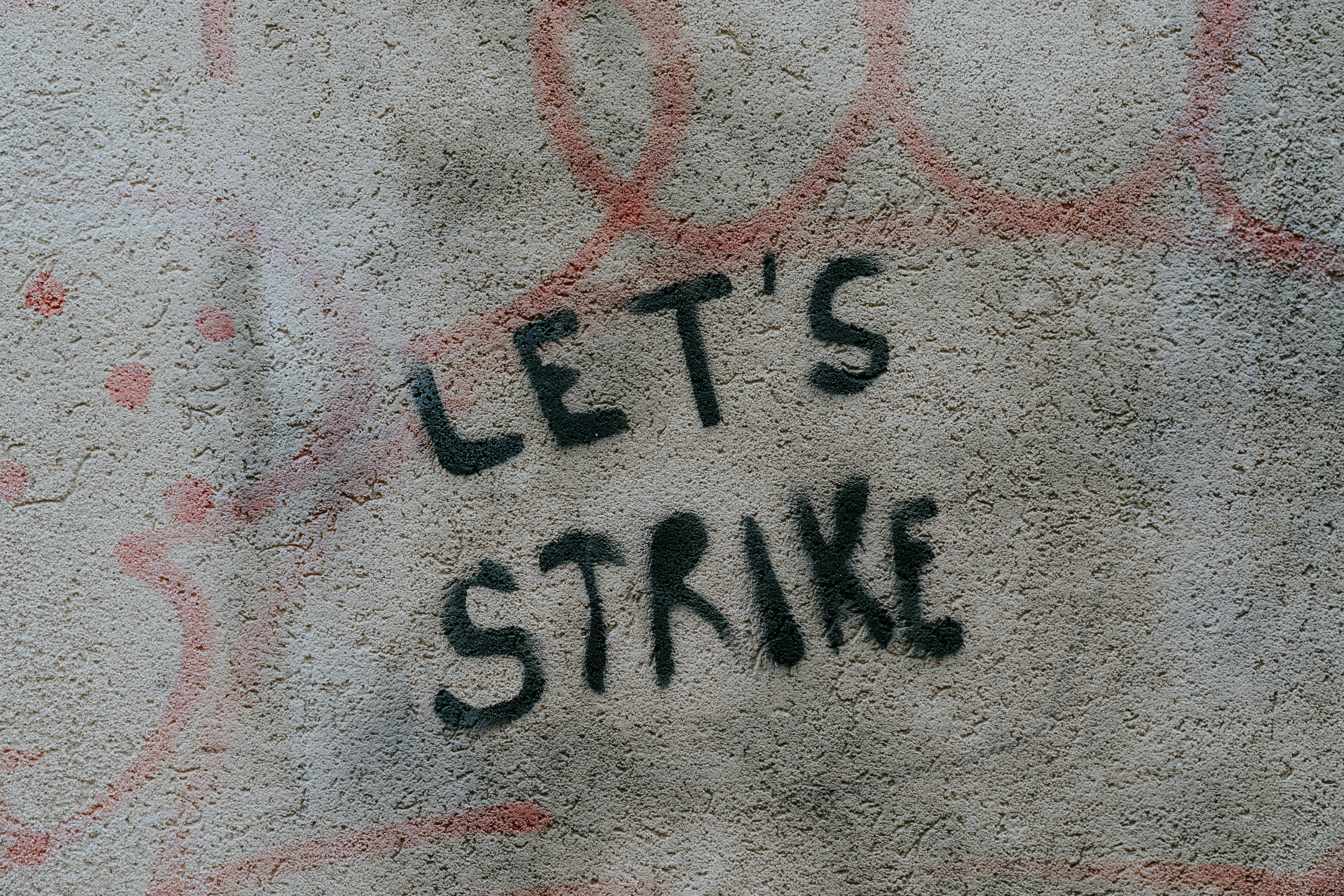
What if we don’t have to shed ‘the blood of tyrants’ to save democracy? What if we just stopped going to work for them?
Note: This article was originally published on Medium on Dec. 1, 2025. An excerpt was also sent to email subscribers of The View from Here. I am republishing it now to make it available without a paywall.
In November of 1948, workers in the British and American-occupied sectors of west Germany (then known as the Bi-Zone Economic Area, Bizonia for short) staged the largest single-day strike in the nation’s history.
More than nine million workers, out of a total workforce of 11.7 million, stayed home from work, shutting down mines, factories, mills, and transit services.
The reason? Skyrocketing inflation sparked by a currency “reform” that had wiped out the savings of most average west Germans, while leaving those with capital — owners of businesses and real estate — largely unscathed.
It was this long-forgotten, one-day action that provided the true impetus for the development of Germany’s reknowned “social market economy,” argues German historian Uwe Fuhrmann, though the strikers never got the credit.
The German economist Ludwig Erhard, who was in charge of economic policy in the Bizone, originally planned an immediate transition to a new currency and purely market-driven prices, intending to ride out the resulting inflation.
“These events [demonstrations and the general strike] put great pressure on West-German politicians,” Fuhrmann writes in the social sciences journal Phenomenal World. “Ultimately, Erhard and other CDU officials were forced to change policy course. In September, the Bizone government pulled the emergency brake in terms of economic policy. This was followed by a discursive shift some weeks later. … To counter the fatal dynamics of privately determined “free” prices, the government reintroduced controls through the backdoor.”¹
This set the stage for the German economic model that balanced market principles with measures that protect social welfare. Though Erhard is credited both as the father of the former West Germany’s postwar economic miracle and the creator of its social market economy, Fuhrmann says the credit should be the workers who took to the streets to demand a seat at the table.
The background
In return for receiving financial assistance negotiated under the Marshall Plan, the west German sectors controlled by the Americans, French, and British were required to adopt a new currency, the Deutsche Mark, which immediately replaced the existing Reichsmark and Rentenmark.
Toward the end of World War II, the Nazi government had been printing money to finance its military and prop up the faltering economy. At the same time, they centrally controlled the availability of food and consumer goods. Food was only available for purchase with government-issued food stamps and other goods with a ration card.
After the war, the German currency was largely worthless. The printed money in circulation was five to six times the estimated value of the economy.
In Berlin, prices rose for basic goods like coal lighters (100%), soap (833%), and candles (2500–4000%). Food prices on the black market were often higher than the legal prices by a factor of more than 100. In Berlin, many prices were posted in Reichsmarks but would only be sold through bartering, such as six bottles of schnapps for three men’s shirts. Workers used more time trading on the black market for essential or profitable supplies than at work. One significant example of an alternate means of exchange at the time was the ‘cigarette currency’ (the “Ami”). In this case, 7 RM constituted about one cigarette.
To get rid of the excess currency, the occupied powers decided to immediately shift to the new Deutsche Mark, and peg its value at 100 RM to 6.50 DM. Each resident of the Trizone (the Bizone areas plus the French sector) would be given 40 DM, initially, plus a follow-up payment of 20 DM, to ensure that everyone would have some cash, regardless of their previous financial situation. RM would only be accepted as legal currency for two months following the release of the Deutsch Mark.
At the same time as the currency reform, Erhard also moved to eliminate all existing price controls. He left in place the caps on wages, however, which had been in place since 1939.
Inflation, which was already high, soared.
Erhard urged patience, saying the prices would level out. But as the summer led to fall, this didn’t happen.
“The result was a wave of social and political unrest in the autumn of 1948,” writes Fuhrmann. “Protests took place in almost every city. Market stalls were looted and large-scale consumer boycotts or “strikes” took place across the country. Housewives “socialized” eggs, which were in particularly high demand. The unions became involved, pushing the anti-inflation movement to a new level.”
Occupation zone borders in Germany, 1947. The territories east of the Oder-Neisse line, under Polish and Soviet administration/annexation, are shown as white as is the likewise detached Saar protectorate. Berlin is the multinational area within the Soviet zone. The red area (above) is Soviet-controlled East Germany. German territory east of the Oder-Neisse line (light beige) was ceded to Poland, while a portion of the easternmost section of Germany East Prussia, Königsberg, was annexed by the USSR, as the Kaliningrad Oblast. Image credit: By 52 Pickup — Own work based on: map data of the IEG-Maps project (Andreas Kunz, B. Johnen and Joachim Robert Moeschl: University of Mainz) — www.ieg-maps.uni-mainz.de. reproduced via Wikimedia Commons, CC BY-SA 2.5.
Eighty percent of the workforce
The difference protests culminated in the massive one-day general strike on November 12. It occurred only among workers in the British and American sectors because striking was prohibited by the French authorities in their sector.
Following an outbreak of violence at protests in Stuttgart, the British and Americans prohibited any more large demonstrations but allowed a “rest from work” to occur.
The German Federation of Trade Unions called for the 24-hour work stoppage on November 12. The demands of the workers were:
Reversal of the preferential treatment of property owners through the currency reform and equalization of burdens in favor of wage earners,
Combating price gouging,
Planning and management of the economy,
Transfer of basic industries and banks into the public sector,
Democratization of the economy and equal participation of trade unions in all bodies of economic self-management.
In an article for the online history site Herne — From Then until Now, Norbert Arndt writes about strikers in the Ruhr region of North Rhine — Westphalia.
And so, on November 12, 1948, the only general strike since the war took place, involving over 9.25 million workers from all sectors of the economy in the Bizone. In North Rhine-Westphalia, 2,100 out of 3,000 factories came to a complete standstill. On average, strike participation was around 80 percent.
In Herne and Wanne-Eickel, too, hardly a hand stirred from midnight to midnight that day. The winding gears of the mine shafts and the machines in the factories stood still, and the offices in the government buildings of both Emscher cities were deserted.
As a result of the increasing pressure from the workers — and to stave off their demands for nationalization of banks and key industries and other long-term reforms — Erhard and the other German leaders relented the removal of all price controls and lifted the wage freeze.
The experience also shaped how they set economic policy going forward.
“When government price schedules, voluntary exhortations, and even fines failed to stabilize consumer markets, production programs were implemented,” Fuhrmann notes. “The government rolled out a program to refurbish discarded military goods for civilian use. But as these new products flooded the markets, their prices only adjusted to those established by the decontrol fiasco. Only an executive order imposing fixed prices and fixed profit margins reestablished some order.”
A production program known as the Everyman Program (Jedermannprogramm), delivered shoes and clothes of a standardized quality to customers at predetermined set prices, he adds.
Instead of direct rationing, the goverment prioritized distribution of the necessary raw materials to companies that agreed to meet certain production standards to ensure business participation. By the beginning of 1949, more than half of all consumer goods sold once again at fixed prices, contravening the Erhard’s original free-market goals.
Why am I telling you this?
At a time in the United States when there is extreme income inequality — company CEOs make on average 256 times the wage of their lowest paid employee — and more than half of Americans cannot find affordable housing, cannot afford health insurance and also have no retirement savings, many people are feeling pushed to the breaking point.
At the same time, the federal government is dismantling programs that protect Americans from natural disasters, from fraud, and from unsafe and abusive workplaces.
Corporate leaders are demanding that their workers work longer hours, for less pay and now — in many cases — to use and train the AI tools that leaders claim will eventually replace them.
Yet the only recourse I hear talked about are consumer boycotts and demonstrations. Or worse …
People openly voice admiration for violent vigilantism like the murders of United Healthcare CEO Brian Thompson, political activist Charlie Kirk, and Minnesota lawmaker Melissa Hortman and her husband, Mark.
But real, lasting social and political change has historically been more often the result of sustained mass, non-violent resistance than targeted acts of terrorism.
Nothing scares billionaires more than messing with their profit margins or their stock price.
Easier said than done
It’s true that unions and even labor strikes occupy a more favorable position in the general German psyche than they do in the American one.
More than half of all jobs in Germany are covered by collective bargaining agreements, compared to 11 percent in the United States.
I wrote about the reasons and the history behind this in more detail here.
The largest general strikes in the history of the United States didn’t turn out nine million people. The largest ones to date also occurred in the immediate aftermath of World War II. The Strike Wave of 1945–56 saw coordinated strikes nationwide, with total participation around 5 million people.
But an uphill battle doesn’t make an impossible one.
Yes, people would have to learn how to come together across political, class, regional and income divides to figure out what they have in common. To developed shared goals and a list of shared demands instead of this free-floating, inchoate anger and resentment.
Americans have been here before and they can peacefully take their country back again. But it will take time and enough hardship to convince people that they must find common ground, even with people they don’t like.
Shawn Fain, president of the United Auto Workers union U.S., has set a deadline to focus on, calling for labor organizers to stage a general strike across the country on May 1, 2028.
As Fain wrote in the left-wing weekly In These Times in 2024: “If we’re to build “enough collective power to win universal healthcare and the right to retire with dignity, then we need to spend the next four years getting prepared.”
It remains to be seen if American workers can join together to fight instead of fighting each other.
¹All quotations and information from original sources have been translated from German to English.
Comment Below