The latest hot spot for digital nomads may not be what it seems
Have you ever run into an old friend or acquaintance you haven’t seen in a long time and were shocked at how much they had changed? Think your old college sorority sister who was engaged to her high school sweetheart and looking at houses in the suburbs the last time you talked. Then you run into her one day a year or two later and she’s ditched the fiance for a girlfriend, and the suburban mini Mansion for a loft downtown.
I mean, people do change. But, it can throw you. Did I ever really know this person?
That’s how I felt when this video from the German YouTube channel Radical Living popped up in my feed.
If you’re not one of his 2.17 million followers, you may not know that he (real name: Matthias K.) was once the preeminent Berlin promoter on YouTube – weaving comedy sketches around videos promoting the city’s coolest neighborhoods, or how to get into the best nightclubs, and why nightclubs in Berlin were superior.
When we moved to the city in 2022, he was part of a group of popular Berlin-based content creators that encouraged a sort of parasocial bonding experience among their followers. Along with Anja Winter from Learn German with Anja and Cari and Janusz from Easy German, they would feature on each other’s channels, encouraging you to learn German and more easily integrate in the country – but also selling you on the ultimate coolness that was life in Berlin.
For a few years just before and after COVID, it really did seem like everyone was moving to Berlin. Another family from our former neighborhood in Atlanta moved to Berlin the month after we did.
There was even a podcast about it.
Over the four years that we’ve lived here, and our idea of life in Berlin transitioned to the reality of life in Berlin, I found myself not tuning in to his YouTube channel as often. Obviously, I never really knew him as a person. (I didn’t even know his name until after his other ‘moving to Japan’ video came out.)
But it was still odd and a little disorienting to see someone who had seemed the epitome of Berlin’s laidback, anything-goes lifestyle suddenly announce he was not only moving to Japan, but leaving Germany permanently. And for some surprising reasons.
About those ‘cheap’ houses
In addition to the video I linked above – which is basically a promotional ad for the English-language real estate search engine Akiyamart – I have noticed a whole slew of new ‘I bought a cheap house in Japan’ videos, lately.
A basic web search turns up even more.
That’s because Japan has been heavily promoting itself as a haven for digital nomads and other independently wealthy people with the ability to purchase real estate and pay Japanese taxes but who won’t depend on the local economy for a job or social services.
RELATED
- Travel and Tour World: Digital Nomads: Japan’s New Strategy to Combat Overtourism and Boost Sustainable Travel
- Japan Times: The 180-day locals: Life on Japan’s digital nomad visa
- MailMate: Can I Live in Japan if I Buy a Property There?
But, if you’re not a self-employed content creator with millions of followers plus a Bitcoin side hustle, you might be surprised at the choice of country.
Yes, Japan has a surplus of cheap, empty houses in the countryside. This is true of many countries that have a rapidly aging and shrinking population. (Italy is another example. You’ll find lots of influencers trying to sell you on moving there, too.)
But most of these villages are suffering from pretty severe depopulation. And you may have a hard time finding other things like doctor’s offices, schools, hospitals, and grocery stores.
Since the mid-1990s, economic growth in Japan – still the world’s fourth largest economy – has stagnated. The government has taken on a lot of debt to deal with the damage caused by disasters like the 2011 Tonohu earthquake and tsunami, as well as the economic damage caused by COVID-19 pandemic.
Similar to the economy in the U.S. and in Europe, real wages have stagnated while prices have risen. This situation, coupled with a weak yen, means average Japanese citizens have less purchasing power than their counterparts in other countries.
Japanese business culture demands long hours at the office, workers regularly report staying past midnight or even sleeping at their workplace. Because childcare and school schedules are designed around the outdated belief that children will have a non-working parent (usually the mom), many women are penalized or forced out of employment when they become mothers.
This has contributed to many women and couples deciding not to have children, which contributes to the cycle of a shrinking population and shrinking workforce.
Now the government of Japanese Prime Minister Sanae Takaichi has chosen to adopt a Trumpian “Japanese First” approach to deflecting blame for the poor economy onto foreign workers, writes Jake Adelstein at the Substack newsletter, Tokyo Paladin.
“Japan’s revised immigration law — passed in 2024, set to take effect in 2027 — lets the government revoke permanent residency from people who’ve held it for years over things like unpaid taxes or social insurance, or, in some readings, simply not carrying your residence card,” he writes. “Japan just told the foreigners who built lives here, who learned the language, paid the taxes, raised the kids, buried the years — you were too slow. No permanent residency. Not because you didn’t earn it, but because it’s easier to blame 3% of the population than to answer for thirty years of decline.”
Income requirements in the new legislation also prohibit foreign workers in low-wage jobs, like elder care, from ever qualifying for permanent residency there.
Adelstein, a journalist and author who has lived in Japan for more than 30 years, says the policy is driving away the workers that Japan desperately needs to support its aging population and will further the economic downward spiral.
“Who doesn’t want to work in a country where they’re not welcome, and you must master a difficult language, that’s really only spoken in one country and your wages are subpar? And when they kick you out because you never will be able to settle here, your savings will be in the doge coin of Asia, leaving you financially screwed. … The smart ones don’t wait around to be blamed for a mess they didn’t make. They just leave. And they don’t come back.”
They want the foreign money, not the foreigners
So, back to Matthias and his newfound love for the “chill vibes” in Osaka.
I doubt he and his family will have to worry about the new visa rules – at least not yet. And normie concerns like long work hours, subpar wages, or good childcare also don’t apply. He doesn’t need a salary.
So, sure, for him, a move to Japan makes sense. But I wouldn’t get too comfortable.
I fear Japan is the latest in a growing number of struggling countries, states and cities that are re-orienting themselves as havens for the super wealthy at the expense of normal people – the ones who work for a salary, from a specific company or job, and not “from anywhere.”
Are we seeing the evolution of Network States in real time? But instead of a single, charismatic founder, they are emerging from the failures of traditional communities.
The government in these places will eventually exist to serve the interests of the local Rich Guys/Girls, and keep order among the masses. All economic and social activity revolving around what the above-mentioned rich folks want, and who can pay top dollar (or yen, as the case may be).
Jackson Hole, Wyoming has the distinction of being the Richest Town in America, but almost all of the people working in its restaurants, businesses and hotels live more than an hour outside of the town and commute in. Even renting in Jackson Hole is unaffordable for all but the private-jet set.
The state of Florida, likewise, does not seem to care that people who work for a living increasingly cannot afford to live, or even visit, there. Their housing, entertainment and recreational venues are gradually reconfiguring themselves to serve an exclusive clientele.
Truthfully, you could name almost any large city or small country and the same would be true. The super-rich are their own virtual economies, and they are influencing and warping the economics of the traditional cities and states they visit and inhabit.
Over time, will society be further divided into a tiny fraction of people living in almost unimaginable luxury, while the rest of humanity leads lives of quiet, increasingly precarious, desperation?
All of us lucky to get paid a (barely) subsistence wage to work for a wealthy financier who also happens to own our house or apartment while also shopping for our groceries at the company store?
We are not the same
I see these content creators and ‘digital nomads’ on YouTube and Tiktok that are promoting moving to rural Italy (or Japan or Portugal – wherever the nomadic destination du jour is) as the ‘bread and circuses‘ of late-stage capitalism.
They are meant to distract us with a fantasy.
The fantasy is that we can chuck it all, give our current corporate overlord the finger, and go homestead on a $6,000 akiya in Hiroshima prefecture.
But the influencers are being sold a fantasy, too. That they are part of that global elite, able to live wherever they want, irrespective of borders, tax laws, or passports.
In reality, they are just glorified guest workers – just like the Vietnamese nationals recruited to work in Japanese care homes, or Filipino hospital nurses in the UK, and Mexican agricultural workers in the United States. The countries and companies want them to turn a profit, but consider them expendable if they ask for too much or it becomes politically expedient.
If you are my age (Gex X) or older, we all saw the proto-influencer bloggers of the early 2000s, the first ones to learn you could make a living selling a fantasy version of your life online. Most of them moved on to better offline pastures. But not all of them survived unscathed.
I won’t be surprised to find out, a few years’ from now, Radical Living living radically somewhere else.
I hope it all works out for him.
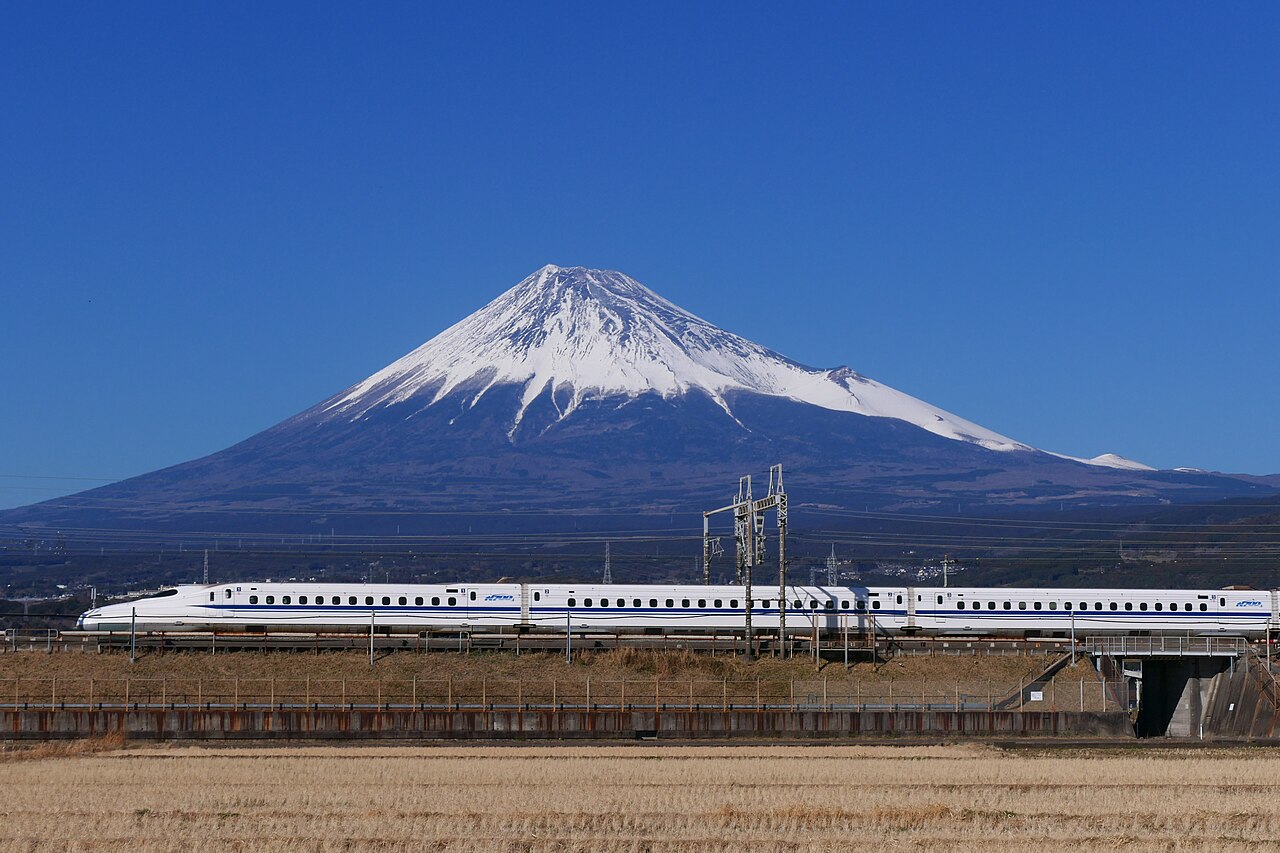
Feature image photo credit: Japan’s Mount Fuji with a high-speed commuter train in the foreground. Photo credit: MaedaAkihiko – Own work, republished through Creative Commons license CC BY-SA 4.0.
Comment Below